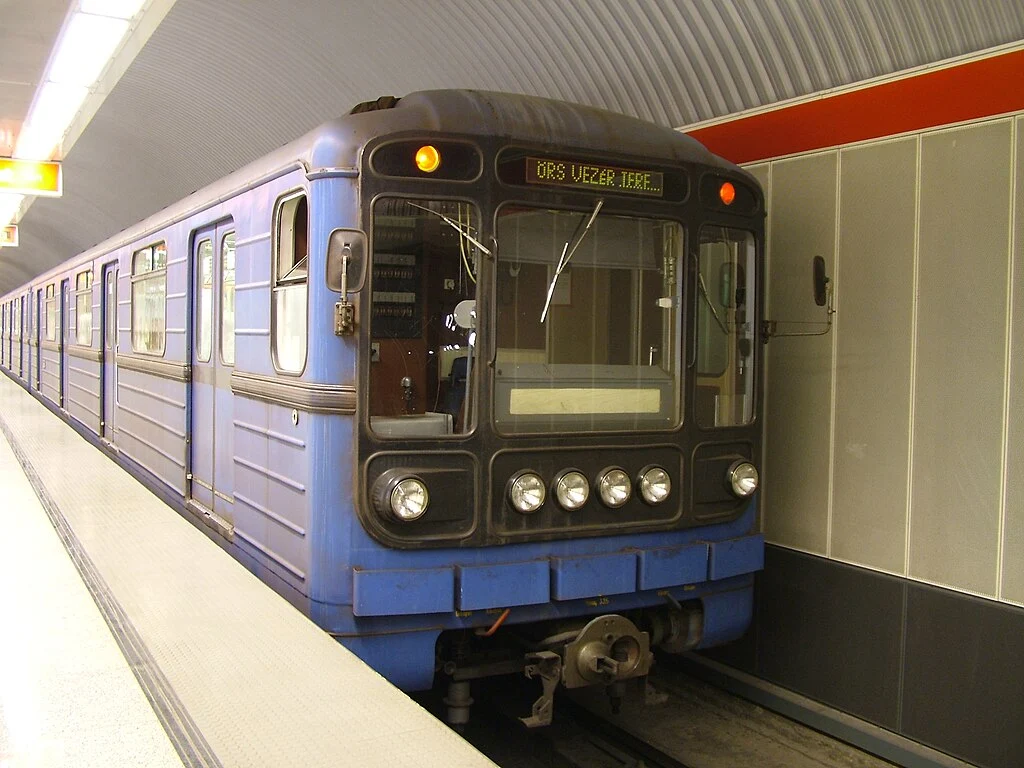
Photo by: Christo, CC BY-SA 4.0
A vintage blue train on the Budapest Metro Line 2, with a sign displaying ‘Örs vezér tere’ at the front, waiting at a station.
Ultimate Budapest Public Transport Guide: Routes, Tickets, Tips & Hidden Gems
The public transport system network in Budapest is one of the most efficient public transport systems in Europe, making it one of the best ways to get around Budapest. The city boasts a well-integrated public transportation system that allows you to seamlessly travel across the city and even sightsee. From buses, trams, and trolleybuses to the oldest metro line in continental Europe, Budapest’s transport services provide reliable and convenient options to explore its vibrant neighborhoods and iconic landmarks.
- Metro Line (Subway)
- Trams
- Bus
- Trolleybus
- HÉV (Suburban Railway)
- Funicular and Cogwheel Railway
- Bubi (MOL Bubi) – Bike
This extensive network is managed by the Budapest Transport Company (BKV) and the Budapest Transport Center (BKK), which ensures that the city’s residents and visitors have access to reliable, safe, and convenient transportation.
BudapestGO is the official mobile application for navigating Budapest’s public transport system, designed to make travel easier and more efficient for both residents and visitors. The app provides real-time information on buses, trams, trolleybuses, and metro lines, helping you plan your journey and avoid delays. With BudapestGO, you can purchase and validate tickets or passes directly through your smartphone, eliminating the need for paper tickets. It also offers route planning with live updates, ensuring you take the fastest or most convenient route to your destination. Whether you’re sightseeing or commuting, BudapestGO is an indispensable tool for getting around the city with ease.
The Four Metro Lines: Fast and Efficient
The Budapest Metro is the backbone of the city’s public transportation system and is the oldest electrified underground railway system on the European continent, second only to the London Underground. The metro system consists of four lines:
- M1 (Yellow Line): Known as the “Millennium Underground,” this line was opened in 1896 to commemorate Hungary’s millennium. It runs from Vörösmarty tér in the city center to Mexikói út, passing through key sites like the Opera House and Heroes’ Square. The historic M1 railway forms part of Budapest’s UNESCO World Heritage property, which includes Andrássy Avenue and the Millennium Underground Railway. Its distinctive stations and yellow trains make it a sightseeing experience in their own right.
- Budapest’s historic M1 metro line, affectionately known as the Kisföldalatti or “Small Underground,” opened in 1896 and was the first underground railway in continental Europe. In October 2026, CNN featured Budapest among 18 of the world’s notable metro systems, highlighting M1’s pioneering electric technology. For visitors, riding its distinctive yellow trains beneath Andrássy Avenue is a sightseeing experience in itself, connecting the city centre with attractions such as the Opera House, Heroes’ Square, and City Park.
- M2 (Red Line): This line connects the eastern and western parts of Budapest, from Déli pályaudvar (Southern Railway Station) in Buda to Örs vezér tere in Pest. It passes under the Danube River, with key stops including Kossuth Lajos tér (near the Hungarian Parliament) and Blaha Lujza tér.
- M3 (Blue Line): The longest metro line in Budapest, the M3 runs from Kőbánya-Kispest in the southeast to Újpest-Központ in the north. It primarily serves the residential areas and is a major commuter route.
- M4 (Green Line): The newest addition, opened in 2014, connects the southwest of Buda at Kelenföld vasútállomás to Keleti pályaudvar, the main international railway station in Pest. The M4 is known for its modern design and state-of-the-art trains.
Metro Operating Hours: The metro operates from approximately 4:30 AM to 11:30 PM. Trains run frequently, with intervals of 2-5 minutes during peak hours.
Trams: Scenic and Convenient

Budapest’s tram system is one of the most scenic and widely used modes of public transport. The city’s tram network is extensive, with over 30 lines crisscrossing the city, offering excellent coverage of both Buda and Pest.
- Tram 2: Often hailed as one of the most beautiful tram rides in Europe, Tram 2 runs along the Pest side of the Danube River, providing stunning views of the Buda Castle, the Parliament building, and the Chain Bridge. It’s a favorite among tourists and photographers alike.
- Tram 4/6: These two lines run along the Grand Boulevard (Nagykörút) and are among the busiest in the city. They connect major stops including Nyugati pályaudvar, Oktogon, Blaha Lujza tér and Móricz Zsigmond körtér, with tram 6 continuing to Móricz Zsigmond körtér and tram 4 terminating at Újbuda-központ.
- Tram 19/41: Running along the Buda side of the Danube, these trams offer a scenic route that passes by Gellért Hill, the Citadella, and the Buda Castle. It’s a great way to see the city’s highlights from the comfort of a tram.
Tram Operating Hours: Trams operate from around 4:30 AM to midnight, with night services available on some routes. Trams generally run every 5-10 minutes during the day.
To reach your destination on Budapest’s trams and buses, it’s important to know the basics of using the system. When your stop is approaching, you may need to pull the black cord or press the stop button to signal the driver that you intend to disembark. Remember that there is always a driver on board to ensure the journey runs smoothly, so don’t hesitate to follow the signage or instructions provided.
Buses and Trolleybuses: Covering Every Corner

Budapest’s bus network complements the metro and tram systems, providing transportation to areas not covered by these services. There are over 200 bus routes in the city, including express lines, night buses, and special services like the airport shuttle bus.
- Express and limited-stop buses: Some Budapest bus routes provide faster journeys by serving selected stops. Check the official BudapestGO journey planner for the most convenient route.
- Night Buses: With a well-organized night bus network, Budapest ensures that the city remains accessible even after the tram and metro services have stopped. These buses operate from midnight until early morning, ensuring that late-night travelers can still move around the city.
- Trolleybuses: Numbered in the 70s, Budapest’s trolleybuses are electric buses powered by overhead wires. They primarily serve the Pest side of the city and are a quieter and more environmentally friendly option.

Bus Operating Hours: Buses generally operate from 4:30 AM to midnight, with night services available. Most routes have frequent services during peak hours, with intervals of 5-15 minutes.
HÉV (Suburban Railway): Connecting the Outskirts

The HÉV suburban railway lines connect Budapest with its suburban areas and nearby towns, making it an essential service for commuters and day-trippers. There are five HÉV lines, described below:
- H5: Runs from Batthyány tér in Buda to Szentendre, a picturesque town known for its art galleries, museums, and baroque architecture.
- H6: Connects Közvágóhíd in Pest with Ráckeve, passing through several suburban districts and offering a glimpse of life outside the city.
- H7: Links Boráros tér with Csepel, an industrial island in the Danube River.
- H8: Connects Örs vezér tere with Gödöllő, home to the Royal Palace. H9: Connects Örs vezér tere with Csömör.
HÉV Operating Hours: HÉV trains typically operate from 4:30 AM to 11:00 PM. Service frequencies vary depending on the line and time of day.
Funicular and Cogwheel Railway: A Touch of Nostalgia

Budapest offers two unique forms of transport that add a nostalgic charm to your journey:
- Budavári Sikló (Buda Castle Funicular): This historic funicular railway connects the Chain Bridge (Clark Ádám tér) with the Buda Castle. Opened in 1870, it offers a short but steep ride up Castle Hill, with spectacular views of the Danube and Pest.
- Cogwheel Railway (Fogaskerekű): The Cogwheel Railway, which dates back to 1874, climbs from Városmajor to the Buda Hills, terminating at Széchenyi Hill. It’s a popular route for those looking to explore the city’s green spaces and hiking trails.
Operating Hours: Both the funicular and cogwheel railway operate from early morning until late evening, with frequent departures.
Bubi (MOL Bubi) – Public Bike

MOL Bubi is Budapest’s public bicycle-sharing service, offering a convenient way to explore the city on two wheels.
The updated system, launched in August 2026, includes both conventional bicycles and electric bikes.
To use the service, download the current MOL Bubi app, register, and follow the instructions to rent and return a bicycle at a designated location.
Check the app for current prices, bicycle availability, and rental conditions before setting off.
Tickets and Travel Cards: How to Travel Smart
Budapest’s public transportation system operates on a unified ticketing system, making it easy to switch between different modes of transport. Here’s what you need to know about tickets and passes:
Ticket Type
Single-journey tickets
- Single ticket: Valid for one continuous journey. Transfers between metro lines are permitted without a new ticket, provided you remain within the metro network. Transfers between buses, trams and other street-level services generally require another ticket.
- Transfer ticket: Allows one transfer between services, subject to BKK’s ticket conditions.
- Block of 10 tickets: A discounted package of individual single tickets.
Time-based tickets and travelcards
- 30-minute and 90-minute tickets: Available digitally, allowing transfers within the validity period when correctly validated.
- 24-hour and 72-hour Budapest travelcards: Provide unlimited travel on eligible services during their validity periods.
Longer-term passes
- Monthly Budapest Pass: Unlimited eligible travel during the pass’s validity period.
- Other passes: Additional options may be available for students, seniors and longer-term travellers.
Ticket prices and available products can change. Always check the official BKK ticket and pass information before purchasing.
Airport exception: The 100E Airport Express has special ticketing rules. Ordinary single tickets and standard Budapest travelcards are not valid on this service. Travellers aged 65 and older can travel free with acceptable proof of age.
Where to Buy:
- Ticket / Vending Machines: Located at metro stations, major tram stops, and bus terminals.
- Newsstands and Convenience Stores: Many sell tickets and passes.
- BKK Customer Service Centres: Located at major transport hubs, offering tickets, passes and assistance with travel planning.
The Importance of Validating Your Transportation Ticket in Budapest
Always make sure you have a valid ticket or pass before travelling on Budapest’s public transport.
- Single paper tickets: Validate your ticket using the designated machine when starting your journey. On buses and trams, validators are located on board; at metro stations, they are located near the entrance.
- Digital tickets: Follow the instructions in BudapestGO. Depending on the ticket and vehicle, you may need to scan a QR code or use an NFC sticker. Time-based tickets must be validated again when transferring to another vehicle.
- 24-hour and 72-hour travelcards: These are valid for their specified period and do not require separate validation for each journey.
- Metro transfers: You can transfer between metro lines using one single ticket, provided you remain within the metro system and do not interrupt your journey.
- Contactless payment: BKK’s Pay&GO system allows passengers to purchase and validate eligible tickets using a contactless bank card or compatible device at supported locations, including all four metro lines.
Ticket inspectors conduct regular checks, so keep your ticket or pass available throughout your journey.
Tips for Visitors
Buy multiple tickets in advance if you’re planning several trips, as this will save time.
Keep your validated ticket or pass with you at all times. Ticket inspectors frequently check passengers, and fines cannot be waived if you are unable to present a valid ticket.
Additional Tips
- Validate as Soon as You Board: It’s best to validate your ticket as soon as you board the vehicle or enter the metro station to avoid forgetting.
- Keep Your Ticket: Even after validating, keep your ticket until you exit the transport system, as you may be required to show it at any time during your journey.
Special note for Seniors
As of 2024, the public transportation system in Budapest is now free for everyone aged 65 and older, regardless of nationality. This change means that both EU and non-EU citizens can use public transport, including metros, trams, buses, and more, without purchasing a ticket. To take advantage of this benefit, seniors need only carry a valid passport or official ID that confirms their age. This policy is a great convenience for senior travelers visiting Budapest from around the world (Budapest Guide).
Travelers aged 65 and older, regardless of nationality, are entitled to free second-class travel on eligible domestic trains throughout Hungary, including InterCity services. Compulsory seat reservations and certain supplements may still require payment. Carry identification showing your date of birth. For current conditions, consult the official MÁV fare and discount information.
FAQ – Budapest Public Transport Guide
Is public transport free in Budapest for tourists over 65?
Yes. Visitors aged 65 and older, regardless of nationality, can travel free on eligible Budapest public transport services. Carry a valid passport or official identification showing your date of birth. Proof of Hungarian residency is not required.
This benefit includes free travel on all public transportation options within Budapest, such as:
Suburban trains (HÉV) within city limits
- Metro
- Buses
- Trams
- Trolleybuses
Is Budapest public transportation good?
Yes, Budapest has one of the most reliable and extensive public transportation networks in Central Europe. It’s efficient, affordable, and covers the entire city, making it easy for both locals and tourists to get around.
What is the best way to get around in Budapest?
The best way to get around Budapest is by combining the metro, trams, and buses. The metro is fast for longer distances, while trams like Tram 2 offer scenic routes along the Danube. Walking is also a great option in the city center.
How can I pay for public transport in Budapest?
You can pay for Budapest public transport with single tickets, travel cards, or passes. Tickets are sold at ticket machines, BKK customer service points, and some newsstands. You can also use mobile apps for digital tickets and passes.
Is the metro in Budapest free?
Budapest’s metro normally requires a valid ticket or pass, although eligible passengers, including visitors aged 65 and older, may travel free. Paper single tickets must be validated before entering the metro’s paid area. Check the official BKK ticket rules for current requirements.